114 years since the raising of the Albanian Flag in Bratilë – The Great Highlands Uprising 1911

114 years ago, on April 6, 1911, during the Great Highlands Uprising, the fighters of Hoti captured the peak of Bratilë and by the order of Dedë Gjon Luli, Nikë Gjelosh Luli raised the red and black Albanian Flag in Bratilë near the peak of Deçiq.
The raising of the Albanian flag was also the culmination of the Uprising and the clearest indication that the goal of the 1911 Malësia Uprising was a struggle with clear aims for freedom, nation, and an Albanian state. For this, the leaders of the seven clans of Malësia—Hot, Grudë, Kastrat, Kelmend, Shkrel, Triesh, Kojë—as well as other tribes outside Greater Malësia, had pledged an oath.
For this flag, the highlanders fought alongside the leaders of the tribes who led the Malësia Uprising, headed by the chief leader of the Uprising, Dedë Gjon Luli.
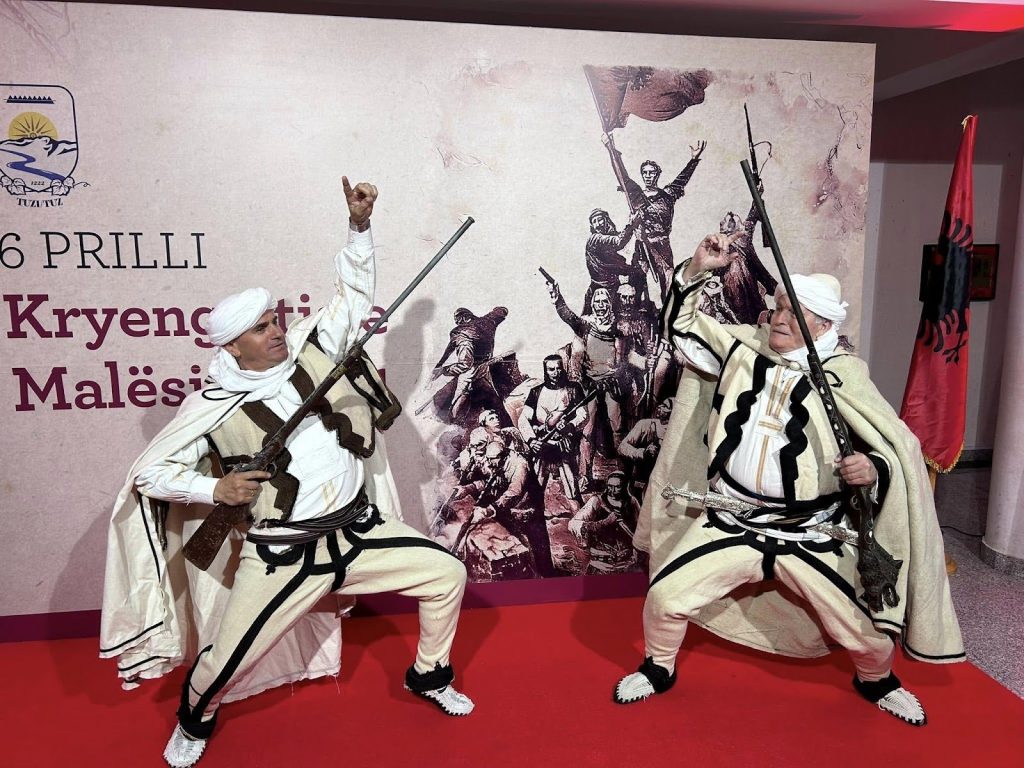
Hot was led by: Dedë Gjon Luli, the vojvoda of Traboin-Hot; Nikë Gjelosh Luli; Gjekë Marash Gjeloshi; Gjon Nikë Plluci; Lulash Zeka; Zef Lan Ula; Kolë Marash Vata; and Dedë Gjoni, all from the Traboin clan.
Nga Rapsha e Hotit, Gjeto Marku, Lucë Muça, Zef Marashi, Luc Marku, Tomë Nikolla (vojvodë) dhe Gjon Pllumi.
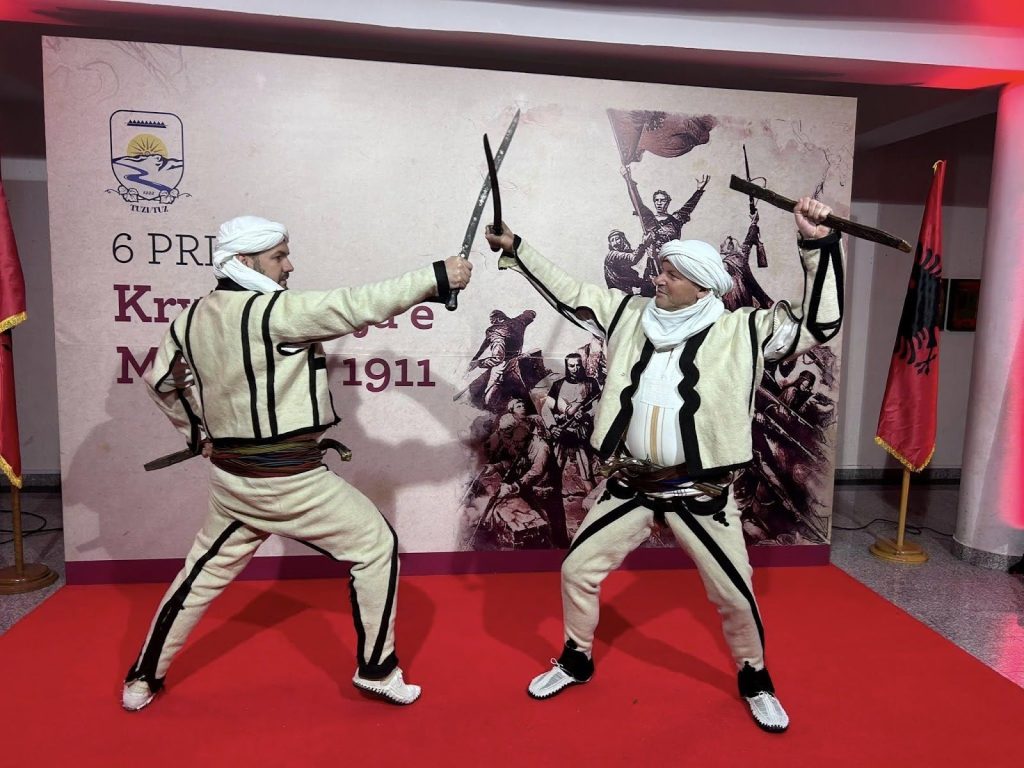
Gruda was led by: Dedë Nika, the standard-bearer of Gruda; Sokol Baci (vojvoda); Kolë Zefi; Tomë Zoli; Marash Dashi; Marash Ujka; Lucë Gjeloshi; Kolë Deda (vojvoda); Tomë Gjoni; as well as Prenk Ujka. In several documents, the daughter of Smajl Martini (the first standard-bearer of Gruda), Tringë Smajlja, is also mentioned.
Kastrat (Selca) was led by: Dodë Prëçi, the standard-bearer of Kastrat; Nikollë Doda; Mark Dashi; Mirash Luca; Gjelosh Gjoka (vojvoda); Pjetër Gjoka; Dedush Marashi; and Lulash Dashi.
Kelmend was led by: Palë Luca (vojvoda); Lucë Marku; Vocërr Preçi; Lucë Gjoni; and the standard-bearer Gjon Voci.
Vukli was led by: Gjon Uci, the standard-bearer; Dosh Prenka; Zef Uci (vojvoda); and Lul Rapuka.
Nga Nikçi: Gjon Sokoli dhe Lulash Kolë Shyti.
From Shkrel: Tomë Nika, Prelë Prëka, and Zef Mali.
From Shala: Mehmet Shpendi (vojvoda), Marash Delia, and Mark Alia.
Trieshi and Koja also participated in the Uprising, even though at that time they were under Montenegro.
Koja was led by the standard-bearer Prëtash Zeka.
The outbreak of the uprising and military actions (March – early June 1911)
The uprising began on March 24, 1911, when the highlanders of Hot, led by Dedë Gjon Luli, Gjek Marash Gjeloshi, and others, initiated armed actions and attacked the border fortification of Rapshë. The movement quickly spread to Gruda, Kelmend, and Kastrat.
The outbreak of the uprising caused panic among the Young Turk authorities in Shkodër. The Ottoman authorities considered using religious fanaticism as a tool to suppress the uprising, aiming to provoke religious divisions and conflicts between Muslim and Catholic Albanians. At the same time, the Young Turks spread rumors in all directions that the rebellious highlanders were instruments of the King of Montenegro, meaning a Christian state. To incite conflict among Albanians, the Ottoman authorities distributed 4,000 weapons to the Muslims of the city and surrounding areas. However, the Muslim population largely ignored this propaganda. Only a small portion of those who received weapons fought against the highlanders. Even they were not concerned with the religious affiliation of Montenegro, but with its now-known intentions toward the Albanian territories and the city of Shkodër itself.
The uprising immediately spread throughout the regions of Greater Malësia. Within a few days, the number of insurgents reached 3,000. On March 28, the rebels captured the town of Tuzi. The small military garrison and government officials were forced to take refuge in the fortress called Shipshanik, located at its top. On March 30, 400 highlanders attacked Koplik but withdrew due to a lack of weapons and ammunition.
On March 30, a meeting of the uprising leaders was held in Cetinë, which approved a memorandum addressed to the Great Powers. This document demanded the inviolability of Albanian territories; that the Albanian language be recognized as the official language in all four vilayets, in offices and courts, and as the language of instruction in schools; that all officials in Albania be Albanian and that Albanian nationality be officially recognized; that budget revenues be spent for the benefit of the country; and that Albanian soldiers not serve outside Albanian lands, except in cases of war. The memorandum was signed by Muharrem Bushati, Isa Boletini, Sokol Baci, Dedë Gjon Luli, Abdulla Aga, Preng Kola, and Mehmet Shpendi. The press of the time emphasized that, although the uprising took place in a narrow region mostly inhabited by Catholics, the rebels emerged with national demands. Essentially, they sought the autonomy of Albania.
On April 6, 1911, fierce clashes took place between the highlanders and Turkish forces from Tuzi to Kastrat. However, the fiercest fighting that day occurred near Deçiq, where 30 soldiers were killed, while seven rebels fell on the battlefield, including their leader, Nish Gjelosh Luli.
On April 8, 200 highlanders held off 1,200 Young Turk forces near Kastrat for six consecutive hours. After the rebels retreated, the troops plundered and burned Bajza in Kastrat.
In order to trap the Albanians between two fires, the Ottoman army command sent four battalions from Gjakova under the leadership of Ethem Pasha. On the night of April 16, as they were approaching Gucia, the Ottoman army was attacked at Hani i Gropës by the residents of Selca. They were unable to continue their march toward the main theater of fighting around Tuzi.
For three consecutive weeks, the Young Turks were unable not only to subdue the highlanders but also to link up with the besieged garrison in Tuzi and reinforce their position in Deçiq.
The premature outbreak of the uprising in the North, caused by pressures from the Montenegrin government, prevented its immediate spread to other nearby regions. The highlanders’ uprising found these parts of the country still unprepared and unorganized for joint armed actions. The northern territories, especially Kosovo, Mirdita, and other regions, had been disarmed by the 1910 expedition. Nevertheless, Isa Boletini and Sulejman Batusha did not give up on efforts to expand the uprising into the areas of the Dukagjin Plain.
Under these circumstances, the northern rebels turned to the Albanians of the South, calling on them to join the uprising. On April 15, 1911, representatives from Kosovo delivered to the southern regions the call that Isa Boletini had issued some time earlier (on March 23) from the mountains of Albania, which stated: “… We have taken all necessary measures and we are not afraid even if the government were to send all its armies… You must, as soon as possible, send people and prepare the population … We must not lose the favorable opportunity we have today.”
The northern uprising also mobilized supporters of armed actions in the southern part of the country. New committees were formed, such as the “Black Society for Salvation,” which sent their representatives to Kosovo. In Kolonjë, a meeting of the movement’s leaders was held, attended by the Kosovar emissaries who delivered Isa Boletini’s letter. It was decided there to accelerate the organization of the armed bands and to start the uprising in the south of the country at the beginning of June.
Përkrahësit e veprimeve kryengritëse
They addressed the people with these words: “Our brothers, the Gegs, are calling us, the sons of Pirro, to come to their aid, and therefore it is the duty of every Albanian to take up arms and join the rebels, and not let the sacred ‘Baba Tomor’ be shamed as it thunders. We want, therefore, the freedom and self-governance of Albania, we want our rights, and we will demand them until we all perish.”
In the Vilayet of Ioannina, in the regions of Korça, Elbasan, Dibra, and Ohrid, the secret committees began distributing weapons and organizing armed bands. On April 16, a meeting was held in the Monastery of Cepo with the leaders of the rebels from Gjirokastër, Delvinë, and other regions of Southern Albania, who swore an oath to rise in armed struggle against the Ottoman Empire.
However, due to the hesitant stance of moderate and wavering elements and the pressure from external factors, the Manastir Committee postponed the preparations for the uprising to an unspecified time, but always within the year 1911.
On April 17, the Turkish General Shefqet Turgut Pasha landed in Shëngjin with eight battalions, 5,000 soldiers, two mountain batteries, a machine-gun division, 800 horses, 10,000 rifles, and numerous military supplies. At the same time, another 20,000 soldiers were being mobilized in Anatolia, in addition to reserve battalions to be recruited in Rumelia, in European Turkey. Preng Bibë Doda also came with Shefqet Turgut Pasha, summoned by the Young Turks from Vienna to pacify Mirdita and prevent its union with the uprising.
The Ottoman armies arrived and disembarked in Shkodër on April 18. The arrival of the new Ottoman forces did not stop the attacks of the rebels, among whom fought patriots such as Luigj Gurakuqi, Hil Mosi, and others. On April 22, the counterattack launched by the Young Turk forces from Shipshanik and Deçiq failed.
In the proclamation published on May 1, 1911, written in Albanian, French, German, and Italian, the rebels once again presented their autonomist program. After discussing the establishment of the Young Turk regime following the Revolution, which was also supported by Albanians, the proclamation declared the following demands of the rebels: 1) Albania should become self-governing, with the protection of the Great Powers under the shadow of Turkey; 2) Albanian schools should be maintained by the government; 3) Albanian soldiers should not serve outside the borders of Albania, except in cases of war.
Meanwhile, the armed clashes became more frequent and fiercer. On May 3, one of the largest skirmishes between the rebels and Ottoman forces took place, after which the path to the center of the vilayet, Shkodër, was opened. Luigj Gurakuqi wrote at the time that “we would have taken Shkodër if we had had weapons.”
The events of the Albanian Uprising of 1911 resonated both inside and outside the country. Volunteers from Italy and Bulgaria, though few, also joined the rebels. The foreign press wrote about the bravery of Albanian women, about the “Albanian Amazons,” who, alongside men, their parents, and brothers, fought against the Ottoman occupiers.
A wide-ranging activity in support of the uprising was carried out within the country by the “Black Society for Salvation.” It worked to collect aid for the northern rebels on behalf of the League “For Freedom or Death.”
In the Albanian diaspora communities in America, Bulgaria, Romania, Egypt (Misir), and elsewhere, conferences were held about Albania and the Albanian struggle against Ottoman rulers. Albanians in America collected a large sum of money for the rebels. It was decided that 30 volunteers would go from America to Southern Albania (Toskëria) to extend the uprising there as well. Fan S. Noli and other patriots tried to secure Greece’s support, but Athens, as before, insisted that the Albanian uprising be carried out only north of the Shkumbin River.
During the month of May, Albanian patriots gathered in Corfu, such as Nikollë Ivanaj, Themistokli Gërmenji, Ismail Qemali, Pandeli Cale, Stefan Kondillari, Spiro Bellkameni, and others, established a branch of the Albanian committee of Bari. Meanwhile, efforts increased to organize the uprising in Southern Albania, where work was underway to secure weapons.
On May 9, Shefqet Turgut Pasha, in response to the rebels’ proclamation of May 1, 1911, published a notice stating that the leaders of the uprising would face a military trial, while those who surrendered within five days, by handing over their weapons and submitting to the laws and orders of the government, would benefit from its mercy. The notice also stated that if attacks were made against the soldiers, the village elders would be punished along with the perpetrator. It was ordered that the loopholes in the highlanders’ towers be either widened or completely closed.
The notice fell into the hands of the rebels on May 11, the day the state of siege was imposed and the military court established in Shkodër. Shefqet Turgut Pasha had long been taking repressive measures, interning the families of those participating in the uprising and of those suspected of having aided it (point 8 of the notice).
The rebels responded to Shefqet Turgut Pasha’s call with a declaration approved at the meeting held in Pikale, signed by 60 of their leaders, which was delivered to the foreign consuls in Cetinë. The document stated that, from the day the Ottoman armies destroyed and burned the houses of the Albanian highlanders, violated the honor of the Albanians, and killed children, they had decided “to stand firm until the last drop of blood in their veins” and “called” the Turkish general “to come out into the battlefield.”
Without waiting for the ceasefire period set in his notice to expire, on May 14 Shefqet Turgut Pasha struck the highlanders by surprise. The Ottoman army of 6,000 men, equipped with artillery and machine guns, again attacked Deçiq. “The forces took these positions,” wrote the Austrian consul in Shkodër, “driving out the rebels bullet by bullet.”
After this operation, the Turks were able to reinforce the Tuz–Deçiq–Kastrat line, stationing 6,000 soldiers toward Shipshanik and another 5,000 from the Koplik side. From the Gucia side, a force commanded by Ethem Pasha continued to pressure the rebels toward Selca, reaching 8 battalions. It kept the Kelmend rebel forces confined, but, without being able to advance, it was forced to return to Gucia.
Facing these Ottoman forces, not counting the numerous troops stationed in Fushë e Shtojit near Shkodër, were only 2,000 Albanian rebels, concentrated between Dinosha and Tuzi.
Shefqet Turgut Pasha, using artillery, destroyed all the villages that resisted. The Ottoman army did not spare even the Muslim highlanders. To escape the Young Turk atrocities, many highlander families—women, children, and the elderly—continued to flee to Montenegro.
Meanwhile, fighting was taking place in Northern Albania. On June 3, 350 highlanders attacked Lezhë and forced the Ottoman garrison to retreat into Atik-Kala. Among the Mirdita fighters who participated in this attack were also Muslim Albanians from Mati, Luma, Dibra, and even from Kosovo. The rebels cut the land and telegraph communications between Lezhë, Shkodër, and Shëngjin.
But after reinforcements began arriving for the Ottoman army from Shëngjin, the rebels were forced to withdraw from Lezhë.
The expansion of the uprising provoked reactions from the political circles of the Great Powers. The Montenegrin government’s intention to directly engage in the armed actions of the rebel highlanders did not find approval, not only in Serbia but also in Russia. The Tsarist government threatened Cetinë that it would suspend the subsidies it provided to Montenegro if it assisted the uprising.
The Austro-Hungarian government, concerned about the possibility of Montenegro intervening in the Albanian-Ottoman conflict, exerted pressure on Cetinë, demanding that it remain neutral. Vienna made every effort to prevent the uprising from spreading to other regions.
To somewhat hinder the expansion of the highlanders’ uprising into other regions of Albania, the “Ittihad ve Terekki” (“Union and Progress”) Committee organized the journey of the elderly Sultan, Mehmed Reşad V, to Kosovo. It was believed that this journey of the Sultan would facilitate the “return to the fold” of those who had strayed from the “Ottoman brotherhood.”
The journey was organized in the form of a pilgrimage to the tomb of Sultan Murad I, who was killed at the Battle of Kosovo Field. The Sultan traveled only in the Kosovo region to isolate this area from the Albanian uprising in Upper Malësia. On June 15, he arrived in Prishtina, where a large military parade was organized, but not as many people gathered as the Young Turks had expected. Fearing that the ceremony at Gazimestan (at the tomb of Sultan Murad) might turn into an anti-Ottoman demonstration, it was quickly concluded with the departure of the Sultan and the accompanying dignitaries. This Young Turk undertaking, as contemporaries assert, was nothing more than a poorly staged comedy.
Meanwhile, the insurgent movement began to expand in the south of the country. In June, the Korçë band (led by Dr. Haki Mborja) went into the mountains, and other bands also began to operate. The spread of the armed movement in the south alarmed Athens. The Russian newspaper Ruskoje Slovo, in a correspondence from Athens, wrote: “The Greek press, which until yesterday showed sympathy for the Albanian uprising, today, since the uprising has also broken out in Epirus, calls the actions of the Albanian committee cunning, as it skillfully seeks to call that province, which is purely Greek, Albanianized.”
On June 17, Shefqet Turgut Pasha, on behalf of the Sultan, once again proclaimed amnesty for the rebels who were to surrender within 10 days, also promising 10,000 lira for the burned houses. In the proclamation issued on this occasion, it was stated that the Turkish government would take care of the needs of the country, to compensate for the recent damages suffered by the Albanians, and to ensure the welfare and peace of the people. However, the proclamation made no mention of any of the national rights of the Albanians.
After the proclamation of June 17, the Young Turks tried several times to enter into negotiations with the rebels, but they failed, as they encountered their determination to fight to the end for their national rights.
Considering that the majority of the highlanders of Upper Malësia were Catholics, Istanbul thought that the most suitable people to enter into negotiations with the highlanders would be Catholic clergy. For this purpose, the Sublime Porte also sought the assistance of the protector of the Austro-Hungarian faith. The Archbishop of Shkodër, Jak Serreqi, who was entrusted with the difficult task of acting as mediator between the Albanian rebels and the Porte, accepted this role, but under certain conditions. The Turkish military and civil authorities formulated an 8-point program to enter into negotiations with the highlanders. These points were far from the demands of the rebels, who had proclaimed their autonomy as early as March. Therefore, the proposed points were not accepted by the leaders of the uprising. Under these circumstances, the mission of the clergy, led by Jak Serreqi, sent to the rebel highlanders, failed.
The number of refugees in Montenegro from Kosovo, Upper Malësia, and the city of Shkodër itself, according to reports from Cetina, reached over 7,000. Most of them were sheltered in Podgorica, Ulcinj, Nikšić, and other places. Among the fleeing highlanders were about 400 from Kastrati, led by voivode Zenel Shabani; 400 from Hoti, under Dedë Gjo Luli; 800 from Shkreli, led by voivode Prend Marashi; and 400 from Gruda, under bajraktar Dedë Nika. In addition, there were 1,200 refugees from Kelmend, Selca, and Postriba. Alongside the men, highlander women also fought, among whom Tringë Smajlja and Norë Kolja stood out. The fighting also included young men as young as 16 and elders up to 70 years old. The leader of the rebels, Dedë Gjo Luli himself, was 71 years old.
Conclusions
The Albanian Uprising of 1911 ended with a partial agreement because it failed to develop into a general uprising. It did not succeed in forcing the Young Turk government to accept the autonomist demands of the Greçë Memorandum.
The acceptance of the demands of Greçë, as Ismail Qemali stated, would have been a victory for Albanian nationalism. The Memorandum also exerted a strong influence in other parts of Albania and encouraged the efforts made to turn the Northern uprising into a general uprising.
The “Red Book” was handed over by representatives of the rebels to the Turkish ambassador in Montenegro, Sadredin Bey, who accepted it without giving any response. To secure the guarantee of the Great Powers for the fulfillment of their demands, a delegation of the rebels, consisting of Luigj Gurakuqi, Dedë Gjo Luli, Sokol Baci, and others, delivered the Greçë Memorandum to the representatives of the Great Powers in Cetinë.
However, contacts were established between the rebels of Northern and Southern Albania, as well as with the diaspora communities. Well-known patriots from various regions of Albania, such as Ismail Qemali, Pandeli Cale, Salih Hoxha, and others, were in Montenegro at that time, alongside the highlanders. Nikollë Ivanaj, Themistokli Gërmenji, and Ismail Qemali also went to the diaspora communities to secure their aid and support. Luigj Gurakuqi, Nikollë Ivanaj, Fadil Toptani, and Themistokli Gërmenji even went to Corfu to work from there for the expansion of the uprising to the south of the country.
However, at the time when the uprising in Upper Malësia was at its peak, the other regions hesitated to rise. Kosovo, which had not yet overcome the devastating consequences of Shefqet Turgut Pasha’s 1910 expedition, found it difficult to join the uprising, while Mirdita, under the influence of Preng Bib Doda and unsettled by Terenc Toçi’s actions, generally adopted a waiting stance. The Southern committees, concerned about the hostile attitude of the Greek government, hesitated to start the uprising in the early period, in May–early June, when the situation was more favorable for its outbreak. The insurgent movement in Southern Albania eventually broke out in July–August 1911, when the uprising of the northern Albanian highlanders had already begun to decline and weaken.
The uprising took place under difficult domestic conditions and unfavorable international circumstances. The Balkan states, viewing Albanian autonomy as an obstacle to the fulfillment of their expansionist aims over Albanian lands, deployed all their forces to hinder the Uprising of Upper Malësia and to prevent it from developing into a general uprising.
The highlanders’ uprising also faced opposition from the European powers, especially Russia and Austria-Hungary, which did not want turmoil in the Balkans. In particular, the Habsburg monarchy was activated, preventing the spread of the uprising throughout the country and trying to keep the Albanian movement within the framework of cultural demands. Italy took the same stance.
Although the 1911 Uprising did not achieve the fundamental objectives of the Albanian National Movement, it holds an important place in the history of the Albanian people. It marked a qualitative step forward in the organization of the national movement and raised the political awareness of Albanians to a higher level.
The Uprising of Upper Malësia, both organizationally and ideologically, marked a significant step forward compared to the 1910 uprising. It was carried out under the leadership of a single center, the Podgorica Committee. Its peak was reached in June, when, by approving (on June 23) the Greçë Memorandum, it proclaimed the demand for Albania’s autonomy as the program of the entire national movement. However, its leadership, despite its efforts, could not draw the other regions of the country into the uprising in Northern Albania, nor turn it into a general uprising.
The 1911 Uprising forced the Ottoman occupiers to enter into negotiations with the Albanians and make some concessions. Although these concessions fell far short of the national demands of the Albanians, they nonetheless provided support for more advanced demands in the future. The uprising highlighted the Albanian issue as an international problem. This is evidenced, among other things, by the interest of British diplomacy in the uprising and, in particular, London’s support for the national demands of the Albanians.
The 1911 Uprising can be regarded as the prologue to the General Albanian Uprising of 1912.
Even after this uprising, the Young Turk government continued its repressive policy in Albania. It did not grant the Albanians the concessions it had made during the agreements with the rebels. As soon as the rebels returned to their homes and the situation calmed down somewhat, it resumed its previous policy. Although demands to grant the same rights enjoyed by the highlanders to other regions of the country were presented throughout Albania, the official authorities in the center and in the provinces tried to limit the scope of the implementation of the agreement with the Albanian rebels. Initially, the government recognized these concessions only for the Sanjak of Shkodër, then only for the uprising area, and finally for the highlanders repatriated from Montenegro, but not for all of Albania.
For the Albanians, however, the agreements with the Young Turks were merely a temporary truce, necessary to regroup their forces and deliver the final blow to Ottoman rule in Albania.


 EN
EN  SQ
SQ